Il Dept of Healthcare and Family Services Child Support
Healthcare is a costly item in national budgets, but who gets the best value for money, and who the best outcomes? We compare the systems in some of the world'due south leading countries for healthcare.
France
Upfront payments: yep
Data: France scores highly on GP numbers and on spending as a percentage of Gdp, but it comes off badly in the Commonwealth Fund'southward international comparison reports, ranking merely 9th out of 11 in the latest cess.
Summary
Nether French republic's land-run equivalent of the NHS, the majority of patients must pay the doctor or practitioner upfront. The land so reimburses them in part or in full. The patient has freedom to cull which physician or service to visit.
All health transactions centre on a smartcard, the Carte Vitale. A GP visit costs €23 (£17), the Carte Vitale is swiped and the coin is paid back into the patient'southward banking company business relationship within five days. In general, the state reimbursement rate is between 70% and 100%. The poorest people and the long-term sick are covered 100%.

Most people are signed up to a mutuelle, a semi-private insurance body, often related to their chore, which tops upwards the remaining amount to be paid. If a patient is taken to the emergency department of a infirmary, for case, they would provide their Carte Vitale, and depending on the health issue, could exist reimbursed fully by the state. However, from November 2017 doctors such every bit GPs will have to waive the upfront fees for all patients, and instead the state and the mutuelle companies volition pay doctors direct. At pharmacies, the patient pays upfront but swipes their Card Vitale. A large number of prescribed medicines are reimbursed between xv% and 100%.
Angelique Chrisafis in Paris
Republic of ireland
Upfront payments: yep
Data: Ireland has more nurses than any other rich country, but its other metrics are distinctly average.
Summary
A GP visit in Ireland typically costs €40-€threescore. However, in 2015 the Irish government abolished charges for children under half-dozen while people with a medical carte or GP visit card as well receive gratis GP care.
In most cases individuals pay for prescriptions from pharmacies capped at €144 per month under the Drugs Payment Scheme. Medical cardholders do non pay for medication but exercise pay a prescription charge of €ii.50 per item (capped at €25 per month per person/family).
Patients are commonly referred for secondary handling by their GP unless they have entered the health system directly through an emergency department. Those attention emergency departments without being referred by a GP are charged €100 (with some exemptions). You are not charged if you are subsequently admitted as an inpatient merely may be liable for infirmary charges. The charge for an overnight stay in a public bed in a public hospital is €75 per mean solar day upwardly to a maximum of €750 in 12 sequent months.
As of the end of September, 46% of the population had health insurance, meaning they could be treated as a private patient in the public organisation or in a private hospital. Public patients who receive handling in private hospitals pay for their own care.
Pamela Duncan
Sweden
Upfront payments: yep
Information: Sweden is ranked third by the Commonwealth Fund, with a high proportion of doctors, above-average healthcare spending, and relatively low prescriptions of drugs.
Summary
Patients wishing to encounter a doctor pay a fee that varies depending on where they live, merely usually about 100-200 kronor (£viii-£sixteen) for adults. Children pay only if they go to emergency rooms, about 120 kronor. For a visit to a specialist you pay up to 400 kronor and for emergency about 400 kronor. A infirmary stay costs 100 kronor a twenty-four hours. You usually pay the same whether yous choose a individual or public clinic or hospital, equally long as the private dispensary is connected to the general healthcare system. And most are.
At that place is a limit to how much you lot pay for healthcare inside a 12-month menstruation. In most regions that is 1,100 kronor, but at that place are regions where the limit is but 900 kronor. Everything is free subsequently that. Prescriptions are subsidised and you lot never pay more 2,200 kronor in a 12-month period.
If you are referred to an skilful, you pay a lower fee of about 100 kronor. If at that place are recurring visits you pay each time, but only up to ane,100 kronor inside a 12-month period. Some regions charge small fees for the cost of an ambulance, about 150 kronor.
But about 600,000 Swedes take a private health insurance – ordinarily paid for by employers. It gives them the ability to skip the queue for procedures and operations, and to go to a medico more apace.
Helena Bengtsson
China
Upfront payments: yes, but low
Data: Communist china scores poorly on simply about every healthcare metric, apart from the growth in how much it spends each year on public health – a sign that it is trying to catch up.
Summary
Hundreds of millions of Chinese citizens lost the right to free public healthcare after the Communist party launched its economic reforms drive in the tardily 1970s.
Today, the cost of a hospital consultation is still relatively low. For those with blue authorities "social insurance" cards, for example, a trip to Beijing's Friendship infirmary tin toll as little 2 yuan (20p). It costs well-nigh 100 yuan to be admitted to A&E while a nighttime in a ward sets a patient back well-nigh the same.

Just the frequently exorbitant cost of medicine and treatment tin can exist enough to ruin a Chinese family.
Authorities officials say they hope to provide affordable healthcare to every Chinese citizen by 2020 and claim 95% of the population now boasts some kind of medical insurance. But in reality fifty-fifty those who do have insurance find information technology often fails to cover their bills.
Poorly paid doctors are notorious for overcharging patients for unnecessary prescriptions while even an ambulance ride to the hospital tin can set you lot back several hundred yuan.
Discontent over this situation has made medicine a unsafe profession in China with a surge in verbal and physical attacks, including murders, confronting doctors in recent years.
Tom Phillips in Beijing
US
Upfront payments: yep
Information: the The states scores poorly on many fronts, ranked 11th out of 11 in the Democracy Fund 2014 list. And yet it far outstrips all its peers in terms of the amount information technology spends on healthcare – a whopping 17% of Gdp.
SummaryUS healthcare is not quite the Darwinian lottery imagined past foreigners. Hospitals are duty-bound to treat emergency cases. Authorities spending pays for a surprising share of visits to the doctor and drugs through a patchwork of public programmes: Medicare for the old, Medicaid for the poor and Chip for children. Since Obama'southward insurance reforms, the per centum of people who have no cover has fallen to "simply" 10% – a mere 33 million people.
For the rest, standards are generally high, sometimes amid the best in the world. But no matter how adept the insurance policy, few Americans can escape the crushing weight of payments hierarchy, or the risk-averse medical practices that menstruation from a fear of lawsuits.
Well-nigh all visits to the medico (often a specialist, rather than full general practitioner) will generate "co-pays" for the patient and revenue streams for the doc that some fear encourages excessive testing and intervention: a consumer, rather than care-led, culture.
Preventive medicine and public health are harder to incentivise. Patchy access to insurance can go out emergency rooms clogged with chronic weather condition. Obesity and mental illness oft get entirely untreated.
Though the arrangement fosters excellence and innovation in places, the messy combination of underinsurance and overinsurance has left the Usa with the highest healthcare costs in the developed globe and some of the worst overall wellness outcomes.
Dan Roberts in Washington
Japan
Upfront payments: no
Data: Japan spends a sharply rising proportion of GDP on healthcare but falls downward on the corporeality of time people spend in infirmary, which is ane of the highest among rich countries.
Summary
Every resident of Nippon is required, in principle, to take out public health insurance. Regular employees are typically covered by a work scheme, and are required to pay 20% of their total medical costs at the betoken of delivery.
Those non covered by their employer – mainly the cocky-employed and unemployed – must bring together the national health insurance scheme. Premiums are based on salary, value of property and the number of dependants, and members pay xxx% of the cost of inpatient or outpatient handling – including emergencies – with the government paying the remainder. People over seventy pay 10% of costs.
Medical fees above a sure ceiling – calculated depending on income and age – are paid in full by the government. Fees are waived for uninsured people on depression incomes who receive government support.
Both public insurance plans cover a range of services, including hospital care, mental health care, prescription drugs, physiotherapy and, significantly, nearly dental intendance.
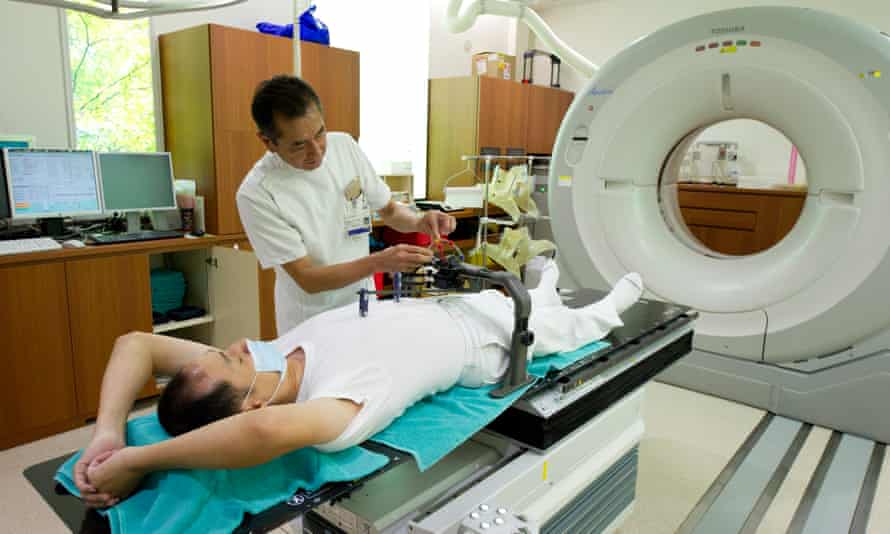
The office of the state in providing healthcare services outstrips many other developed countries. In 2012, 82% of health spending was publicly funded, compared with an OECD average of 72%.
Universal health coverage has been credited with contributing to Japan's impressive longevity statistics, but the growing elderly population is calculation to healthcare costs. Lengths of infirmary stays are almost twice as long as in other countries.
Japan spent 8.half-dozen% of Gross domestic product on healthcare in 2008, according to OECD figures. By 2013 that had risen to 10.3%, largely because of the ballooning cost of caring for older people.
Justin McCurry in Tokyo
Spain
Upfront payments: no
Data: Spain has a relatively high number of doctors – and a low number of nurses – proportionate to its population, merely the corporeality it spends on healthcare has started to fall amid the economic crunch.
Summary
Spain offers free, universal healthcare to anyone resident, legally or illegally, in the country, as well equally to tourists and other visitors. Since 2012, undocumented foreigners have been entitled just to emergency intendance. Some ninety% of Spaniards utilise the system, with about xviii% signing upward to private healthcare schemes, including many public sector workers who are given the pick of free, private care. Most dental and centre care is carried out in the private sector.
The system is decentralised across the country'due south 17 democratic regions and and so the quality of intendance, and in particular admission to specialist procedures or units, varies. This leads to a degree of internal health tourism. In a contempo poll, medical professionals, said nine out of x of the all-time hospitals were in either Madrid or Barcelona. Some regions, notably Catalonia, accept implemented deeper spending cuts than others, leading to longer waiting lists and some migration towards the private sector.
Stephen Burgen in Madrid
Italy
Upfront payments: in some cases
Data: loftier doctor ratios, high numbers of pharmaceutical prescriptions.
Summary
In Italian republic, the national health service, Servizio Sanitario Nazionale, offers universal health coverage that is gratis or low cost at the signal of delivery and covers the vast majority of drugs.
It is recognised by independent experts as offering affordable and high quality care, though at that place are regional differences in the standard of some state-run hospitals, with facilities in northern Italy being considered meliorate than those in the south. Citizens can also buy individual insurance, which some exercise to avoid waiting times for doctors' visits.
The national insurance scheme is offered to all European citizens, and includes full coverage – paid for by full general taxes – of inpatient treatments, tests, medications, surgery, emergency care, paediatrics and access to a family doctor. According to Italy's health ministry, the list of pharmaceuticals that are covered by national insurance is the most complete in Europe, with patients having to pay for simply products that treat minor disorders.
The ministry said Italy is likewise the only land in Europe that allows families to choose a paediatrician for children until age fourteen at no charge.
Stephanie Kirchgaessner in Rome
Deutschland
Upfront payments: no
Data: middle of the pack. Frg was positioned fifth in the latest Commonwealth Fund rankings, spending more than the European union boilerplate on healthcare – but its lengths of stay in hospital tend to exist higher than in other countries.
Summary
In Germany's healthcare organisation, which goes dorsum to Otto von Bismarck's social security programme of the 1880s, anyone residing in the land is required to take out a health insurance scheme.
About 85% of the population do this by taking out insurance with one of the land'south 124 non-profit Krankenkassen or "sickness funds": public insurers, many of whom are small and linked to trade unions. Membership rates are well-nigh 15% of monthly salary, one-half of which is paid by employers.
Those who earn more than €iv,350 (£3,300) a month can take out insurance with a private company, an option that is mainly popular with freelancers and the cocky-employed. For welfare recipients, health insurance membership is covered past local authorities.

Membership covers GP and registered specialists as well as bones dental care. If you lot are taken to hospital, your public health insurance kicks in once you lot are charged more than €ten a twenty-four hours, covering inpatient care with the doctor on duty at your nearest hospital.
Information technology doesn't comprehend private doctors or private rooms at a hospital, homeopathic handling or more advanced dental treatment. Patients pay for 10% of prescription drugs, with a minimum of €five and a limit of €ten per medication per prescription.
Since 2013, patients in Germany no longer have to pay a consultation fee of €ten when seeing a doctor. They can now also become straight to a specialist, rather than waiting to exist referred past a GP.
Philip Oltermann in Berlin
Russia
Upfront payments: no
Information: Russia has a relatively big number of doctors, merely its healthcare spending is depression and outcomes are generally poor.
Summary
On paper, the Russian health service is gratis to all. In practice, a circuitous compulsory medical insurance organization plus low wages for doctors and nurses ways that without substantial bribes, gaining a decent level of care outside the better individual clinics is most impossible. The horrific case in December in which a md in Belgorod punched a patient in the face, who fell to the floor and afterwards died, put the spotlight on the poor care many Russians receive.
There are many efficient and modernistic individual clinics in Moscow, but in the regions ageing Soviet infrastructure and outdated medical practices are widespread. Medicine is widely available, and many drugs that are prescription-only in Britain are bachelor over the counter. The Russian tendency to overprescribe ways that Russians often spend huge amounts on medicines.

Emergency care is too free in theory, but private ambulances often go far much quicker than state-provided ones, and there are also reports of ambulance crews demanding money to take patients to hospital. Near middle-class Russians accept private wellness insurance, or simply pay upfront at private clinics when required.
Shaun Walker in Moscow
Australia
Upfront payments: yes
Data: Australia scores well in comparative datasets, ranking 4th in the Democracy Fund table, with high numbers of doctors and average amounts of national wealth devoted to healthcare.
Summary
Most people pay to see a GP, which costs about $50-$80 (£24-£38). About half of this is reclaimable via a nationwide Medicare insurance scheme.
Some GP surgeries offer "bulk-billing", which means they but charge the reclaimable fee, so patients exercise not have to pay anything to see the doctor. Low-income earners and pensioners who have a government-issued healthcare bill of fare are always bulk-billed.
Well-nigh prescriptions are subsidised through the Pharmaceutical Benefits Scheme (PBS).
Handling in public hospitals is completely covered by Medicare, though people with private health insurance often elect to utilise private hospitals.
Ambulances are not covered by Medicare. Some states fund ambulances through an almanac levy, though others accuse $300-$ii,000 (£150-£950) for an emergency ambulance callout. This goes up to $10,220 (£5,000) for an emergency callout of a helicopter in Victoria. Many people have ambulance comprehend as part of their health insurance.
In 2011-12, 57% of adult Australians had private health insurance, particularly older people, loftier earners and women in their 20s and 30s who use it for maternity care.
Kate Lyons
United kingdom of great britain and northern ireland
Upfront payments: no
Data: the UK came first in the latest Republic Fund assessment of healthcare systems around the rich world, just other surveys such as a European one earlier this calendar month are not so flattering. Healthcare spending as a proportion of Gdp is falling behind international averages, and an elderly demographic, the obesity epidemic and alcohol bingeing are all taking their toll. The UK likewise has the worst cancer outcomes of whatsoever rich land.
Summary
A mission statement prepare in 1948 for a universal service complimentary at the point of utilize is under strain like never before. People are notwithstanding able to see a GP free of accuse – though booking an appointment is becoming harder. It will toll nothing to call out an ambulance and go through A&E, to undergo chemotherapy or major surgery. And yet about eleven% of the population adopt to pay for private health insurance.
Mark Rice-Oxley
For more on the state of Uk'southward NHS, go to our series page.
wallacesathimpiou1996.blogspot.com
Source: https://www.theguardian.com/society/2016/feb/09/which-country-has-worlds-best-healthcare-system-this-is-the-nhs
0 Response to "Il Dept of Healthcare and Family Services Child Support"
Publicar un comentario